
A System Dynamics Design Approach
Download the PDF Version here: Navigating towards Decoupled Aquaponic Systems
Simon Goddek 1,2,*, Carlos Alberto Espinal 3 , Boris Delaide 4, Mohamed Haissam Jijakli 4, Zala Schmautz 5, Sven Wuertz 6 and Karel J. Keesman 1
1 Biobased Chemistry and Technology, Wageningen University, P.O. Box 17, Wageningen 6700 AA, The Netherlands;
2 Aquaponik Manufaktur GmbH, Geldener Str. 139, Issum 47661, Germany
3 LandIng Aquaculture, Evenheuvel 4, 5688 LZ Oirschot, The Netherlands;
4 Integrated and Urban Plant Pathology Laboratory, Université de Liége, Avenue Maréchal Juin 13, Gembloux 5030, Belgium;
5 Institute for Natural Resource Sciences, Zurich University of Applied Science (ZHAW), Grüental, Wädenswil 8820, Switzerland;
6 IGB, Ecophysiology and Aquaculture, Müggelseedamm 310, Berlin 12587, Germany;
* Correspondence:
Academic Editor: Giuliana Parisi
Received: 24 February 2016; Accepted: 12 July 2016; Published: 21 July 2016
Received: 24 February 2016; Accepted: 12 July 2016; Published: 21 July 2016
Abstract: The classical working principle of aquaponics is to provide nutrient-rich aquacultural
water to a hydroponic plant culture unit, which in turn depurates the water that is returned to the
aquaculture tanks. A known drawback is that a compromise away from optimal growing conditions
for plants and fish must be achieved to produce both crops and fish in the same environmental
conditions. The objective of this study was to develop a theoretical concept of a decoupled aquaponic
system (DAPS), and predict water, nutrient (N and P), fish, sludge, and plant levels. This has been
approached by developing a dynamic aquaponic system model, using inputs from data found in
literature covering the fields of aquaculture, hydroponics, and sludge treatment. The outputs from the
model showed the dependency of aquacultural water quality on the hydroponic evapotranspiration
rate. This result can be explained by the fact that DAPS is based on one-way flows. These one-way
flows results in accumulations of remineralized nutrients in the hydroponic component ensuring
optimal conditions for the plants. The study also suggests to size the cultivation area based on
P availability in the hydroponic component as P is an exhaustible resource and has been identified
one of the main limiting factors for plant growth.
Keywords: aquaponics; aquacultural engineering; sludge treatment; agriculture; anaerobic digestion;
phosphate recycling
water to a hydroponic plant culture unit, which in turn depurates the water that is returned to the
aquaculture tanks. A known drawback is that a compromise away from optimal growing conditions
for plants and fish must be achieved to produce both crops and fish in the same environmental
conditions. The objective of this study was to develop a theoretical concept of a decoupled aquaponic
system (DAPS), and predict water, nutrient (N and P), fish, sludge, and plant levels. This has been
approached by developing a dynamic aquaponic system model, using inputs from data found in
literature covering the fields of aquaculture, hydroponics, and sludge treatment. The outputs from the
model showed the dependency of aquacultural water quality on the hydroponic evapotranspiration
rate. This result can be explained by the fact that DAPS is based on one-way flows. These one-way
flows results in accumulations of remineralized nutrients in the hydroponic component ensuring
optimal conditions for the plants. The study also suggests to size the cultivation area based on
P availability in the hydroponic component as P is an exhaustible resource and has been identified
one of the main limiting factors for plant growth.
Keywords: aquaponics; aquacultural engineering; sludge treatment; agriculture; anaerobic digestion;
phosphate recycling
1. Introduction
Aquaponics may be defined as an integrated quasi closed-loop multi-trophic food production
system comprising a recirculating aquaculture system (RAS) and a hydroponic unit. In an aquaponic
system, the nutrient-enriched water derived from the fish is directed to the hydroponic unit providing
nutrients for plant growth. The appeal of aquaponics lies on its capacity to produce aquatic animals
(e.g., fish, crayfish, etc.) and plants (e.g., vegetables, herbs, medical plants, fruits, etc.) in an
environmentally-friendly way, ensuring high levels of water reuse [1] and nutrient recycling [2,3].
Despite varying water quality requirements in both RAS and hydroponic production units, the
traditional aquaponics practice has been based on compromising the needs of plants and fish within
a single water process loop, thereby reducing the efficiency of aquaponic systems compared to the
sum of single crop production, fish and plant, respectively [4]. Although many aquaponics systems
are constructed and operated as a recirculating loop, commercial growers and researchers carry on
expanding this initial aquaponics system design towards an independent control over each system
unit (i.e., RAS, hydroponics, and nutrient recovery via sludge remineralization). Systems where
fish, plants and, if applicable, remineralization are integrated as separate functional units comprising
individual water cycles that can be controlled independently, are called decoupled aquaponic systems
(DAPS). Still, as a matter of fact, system design aims at a high degree of self-sufficiency of the entire
system. Components are consequently designed and sized in the way that the required manipulation
to adjust conditions within the cycle can be minimized. Recently, Kloas et al. [5] presented a DAPS
comprising a RAS and a hydroponic unit arranged as two individual water cycles, where water loss
due to evapotranspiration of the plants was replaced on demand via a one way valve from the RAS,
which in turn was refilled with tap water. Thereby, an improved control of the nutrient flows as well
as optimized species-specific water conditions in both units were achieved. The fate of this approach is
that the water consumption (i.e., mainly evapotranspiration rate) is the decisive factor of DAPS, as it
defines the water replacement and water quality in the RAS as well as the nutrient supply for the plants,
if no additional supplementation/fertilization is carried out. Consequently, understanding the impact
of water and nutrient flows within such systems is crucial for determining their conceptual framework.
Growth advantages of DAPS have been observed in lab-scale experiments [6,7]. Jijakli et al. [6]
observed an increased plant growth of 39% compared to a pure hydroponic control nutrient solution
when supplementing the hydroponic component with additional fertilizer. Moreover, Goddek [7]
showed that anaerobic digestates also increased plant growth. To our knowledge, the concept of DAPS
has not yet been applied to systems comprising more than two units. In this study, we extended the
concept by integrating a third functional unit for the remineralization of RAS derived sludge. Similar to
a food web, a number of functional units representing different trophic levels such as autotrophic
producers (plant crops), heterotrophic consumers (fish, crustaceans, molluscs) and decomposers
(remineralization unit) could be arranged in individual, though communicating water cycles, providing
a better control of the nutrient flows and increasing the efficiency of the production and reducing
emissions further. Most importantly, such concept may allow for better fine tuning of nutrient flows
between several units and may add stability with regard to imbalances or disturbances.
Nutrient dynamics in one-loop integrated aquaculture-hydroponic systems have first been
investigated by Seawright et al. [8]. However, nutrient flows and accumulations were not
comprehensible due to unreported nutrient supplementations. A nitrogen (N) balance study for
one-loop aquaponic systems was conducted by Graber and Junge [2] and Licamele [9], who observed
that growth of hydroponic and aquaponic lettuce was similar even though the lettuce in the hydroponic
system was exposed to a solution with a higher nutrient concentration. Another mass balance study has
been conducted by Neto and Ostrensky [10] who estimated the nutrient load and waste productions
in tilapia cage production systems. Regarding the nutrient flow from RAS to the plants in one-loop
systems, several authors have made examinations of this issue and observed low levels of P, potassium,
magnesium, manganese, iron, and sulphur [1,2,9,11–13]. Consequently, the plant growth performance
could probably even be improved by providing a sufficient amount of nutrients, which can either be
achieved by supplementation [4,14], or remineralization of fish sludge as observed in several studies
comprising mass balance approaches [15–17].
2. Objectives and Scope
Typically, models are created to understand, predict, and control complex dynamic systems [18].
The scope of this study is to develop a system dynamics model for N, phosphorus (P), water, fish,
plants, and sludge (aquacultural biosolids), based on a decoupled system approach. The reason why
the macronutrient P is used in this paper is due to the fact that it is an exhaustible resource [19].
Even though it is mostly sufficiently available in the fish feed, other more available nutrients can be
supplemented to the hydroponic component. The system dynamics model of this study can be used
to design and further optimize systems. The main objective of this paper is to present a theoretical
design approach for DAPS by addressing the scope’s conceptual criteria, and coping with design
drawbacks based on the model’s outcome. The model elaborated in this paper assesses the system’s
organic loading rates to achieve optimal conditions for both hydroponic and RAS components of the
system under given conditions. This will lead to a perspective that covers the evaluation regarding
the need for further studies that have to be pursued to develop and improve a plant-wide model for
decoupled aquaponic systems.
Typically, models are created to understand, predict, and control complex dynamic systems [18].
The scope of this study is to develop a system dynamics model for N, phosphorus (P), water, fish,
plants, and sludge (aquacultural biosolids), based on a decoupled system approach. The reason why
the macronutrient P is used in this paper is due to the fact that it is an exhaustible resource [19].
Even though it is mostly sufficiently available in the fish feed, other more available nutrients can be
supplemented to the hydroponic component. The system dynamics model of this study can be used
to design and further optimize systems. The main objective of this paper is to present a theoretical
design approach for DAPS by addressing the scope’s conceptual criteria, and coping with design
drawbacks based on the model’s outcome. The model elaborated in this paper assesses the system’s
organic loading rates to achieve optimal conditions for both hydroponic and RAS components of the
system under given conditions. This will lead to a perspective that covers the evaluation regarding
the need for further studies that have to be pursued to develop and improve a plant-wide model for
decoupled aquaponic systems.
3. Methodology and Data Sources
3.1. Dynamic Systems Analysis
Dynamic systems analysis was used to evaluate the N, P, fish (i.e., tilapia), plant (i.e., lettuce plant),
and water balance within DAPS. This method also enabled us to assess the impact of a remineralization
component on the overall system’s performance, as well as sizing the hydroponic part depending on
different evapotranspiration rates. However, as a basis for physically-based dynamic modeling, as
opposed to data-driven modeling, well-grounded flow charts and causal loop diagrams (CLD) are
required [18]. Whereas flowcharts provide an overview of all procedures considered necessary in the
context of a comprehensive diagnostic process, CLDs represent a fundamental tool to understand and
illustrate complex systems. Both served as foundation plans and constituted the basis for the software
computer model.
Although CLDs are a good tool to identify causal relationships between activities or events and
their latent effects, they need to be combined with the factor time to simulate and reveal short to long
term impact factors and changes due to e.g., accumulations, fluctuations in temperature and fish
biomass, etc. The resulting system dynamics models allow analyzing the interplay of key factors in
order to reveal key leverage points and optimal conditions and system settings. Here, the specific
system modeling software AnyLogic was used [20]. For the CLDs (that can be seen in Figures B1–B3)
the following choices were made: (1) RAS, hydroponics, and sludge remineralization are displayed
independently to constitute the need for different conditions in each sub-system; and (2) in the
RAS component, a nitrifying biofilter is included in the model. Laying the basis for the models,
assumptions for the flow charts are: (1) there is no need to exchange water in addition to the water
replacement as consequence of evapotranspiration; (2) it is provided that the RAS components contain
biofilters of adequate size to fully transform total ammonia nitrogen (TAN) into nitrate; and (3) nutrient
supplementations for the hydroponic units are not taken into account.
The system dynamics model simulations were based on a decoupled system with four fish tanks.
The modeling procedure was divided into four steps: (1) Before N, P, water, tilapia, lettuce, and
sludge flows were simulated, a parameter variation experiment was run in order to estimate the
amount of fish that needed to be incorporated to the system to have a maximum stocking density of
50 kg x m-3. For higher densities the use of pure oxygen could be required; (2) Given this data, the plant
cultivation area for maximum nitrogen-nitrate (N-NO3) water concentration for sensitive and resistant
fish species (i.e., trout and tilapia) was simulated using a parameter variation experiment depending
on crop evapotranspiration rates (ETc) under natural and artificial light conditions. For trout the
limit was set to 40 mg x L-1 N-NO3 [21–23], for tilapia to 200 mg x L-1 N-NO3; (3) P was used as an
alternative design parameter to size the hydroponic component since it is often limiting plant growth
and global mineral resources are finite. However, if the obtained size suggestion does not correspond
with the needed water exchange rates, active denitrification in the RAS is required. For this study,
an optimization step was conducted, which determined the amount of lettuce that can be produced
with RAS-derived nutrients and remineralized P inflow from an anaerobic nutrient remineralization
component (ANRC). In this study, the ANRC was composed by an upflow anaerobic sludge blanket
(UASB) reactor. UASB reactor performance parameters were used to determine the remineralization
rates; (4) Given the P parameter the flow of the UASB was determined.
3.1. Dynamic Systems Analysis
Dynamic systems analysis was used to evaluate the N, P, fish (i.e., tilapia), plant (i.e., lettuce plant),
and water balance within DAPS. This method also enabled us to assess the impact of a remineralization
component on the overall system’s performance, as well as sizing the hydroponic part depending on
different evapotranspiration rates. However, as a basis for physically-based dynamic modeling, as
opposed to data-driven modeling, well-grounded flow charts and causal loop diagrams (CLD) are
required [18]. Whereas flowcharts provide an overview of all procedures considered necessary in the
context of a comprehensive diagnostic process, CLDs represent a fundamental tool to understand and
illustrate complex systems. Both served as foundation plans and constituted the basis for the software
computer model.
Although CLDs are a good tool to identify causal relationships between activities or events and
their latent effects, they need to be combined with the factor time to simulate and reveal short to long
term impact factors and changes due to e.g., accumulations, fluctuations in temperature and fish
biomass, etc. The resulting system dynamics models allow analyzing the interplay of key factors in
order to reveal key leverage points and optimal conditions and system settings. Here, the specific
system modeling software AnyLogic was used [20]. For the CLDs (that can be seen in Figures B1–B3)
the following choices were made: (1) RAS, hydroponics, and sludge remineralization are displayed
independently to constitute the need for different conditions in each sub-system; and (2) in the
RAS component, a nitrifying biofilter is included in the model. Laying the basis for the models,
assumptions for the flow charts are: (1) there is no need to exchange water in addition to the water
replacement as consequence of evapotranspiration; (2) it is provided that the RAS components contain
biofilters of adequate size to fully transform total ammonia nitrogen (TAN) into nitrate; and (3) nutrient
supplementations for the hydroponic units are not taken into account.
The system dynamics model simulations were based on a decoupled system with four fish tanks.
The modeling procedure was divided into four steps: (1) Before N, P, water, tilapia, lettuce, and
sludge flows were simulated, a parameter variation experiment was run in order to estimate the
amount of fish that needed to be incorporated to the system to have a maximum stocking density of
50 kg x m-3. For higher densities the use of pure oxygen could be required; (2) Given this data, the plant
cultivation area for maximum nitrogen-nitrate (N-NO3) water concentration for sensitive and resistant
fish species (i.e., trout and tilapia) was simulated using a parameter variation experiment depending
on crop evapotranspiration rates (ETc) under natural and artificial light conditions. For trout the
limit was set to 40 mg x L-1 N-NO3 [21–23], for tilapia to 200 mg x L-1 N-NO3; (3) P was used as an
alternative design parameter to size the hydroponic component since it is often limiting plant growth
and global mineral resources are finite. However, if the obtained size suggestion does not correspond
with the needed water exchange rates, active denitrification in the RAS is required. For this study,
an optimization step was conducted, which determined the amount of lettuce that can be produced
with RAS-derived nutrients and remineralized P inflow from an anaerobic nutrient remineralization
component (ANRC). In this study, the ANRC was composed by an upflow anaerobic sludge blanket
(UASB) reactor. UASB reactor performance parameters were used to determine the remineralization
rates; (4) Given the P parameter the flow of the UASB was determined.
3.2. FAO Penman-Monteith Equation
The evapotranspiration rate is dependent on net radiation, temperature, wind velocity, relative
humidity, and crop species [24,25]. Net solar radiation can be determined using the FAO
Penman-Monteith equation [25]. This equation is initially developed for outdoor environments,
but can be adjusted for greenhouse crop production [24,26]. Instead of a total dependency on
nature, both greenhouse characteristics and climate control equipment have a high impact on the
evapotranspiration [27,28]. Fernández et al. [29] report a reduced reference evapotranspiration (ETo) by
21.4%, when using plastic greenhouses in Spain. Greenhouses also reduce the wind speed considerably,
which has a reducing impact on the reference evapotranspiration [29,30]. Surface covers as they are
used, for instance in nutrient flow techniques (NFT) or deep water culture (DWC) methods are reported
to reduce the single crop coefficient (Kc) [25] that is multiplied with the reference evapotranspiration to
receive the crop evapotranspiration. Licamele [9] reported that plant density of 32 lettuce plants m´2
required 1 L of water each. These findings were consistent with the estimated covered single crop
coefficient (Figure 1). Therefore a comparative analysis was conducted with AnyLogic to estimate
the range of expected evapotranspiration rates under constant lighting conditions of 200 W x m-2
for 16 h x day-1 and the sole use of natural light.
3.2. FAO Penman‐Monteith Equation
The evapotranspiration rate is dependent on net radiation, temperature, wind velocity, relative
humidity, and crop species [24,25]. Net solar radiation can be determined using the FAO Penman‐
Monteith equation [25]. This equation is initially developed for outdoor environments, but can be
adjusted for greenhouse crop production [24,26]. Instead of a total dependency on nature, both
greenhouse characteristics and climate control equipment have a high impact on the
evapotranspiration [27,28]. Fernández et al. [29] report a reduced reference evapotranspiration (ETo)
by 21.4%, when using plastic greenhouses in Spain. Greenhouses also reduce the wind speed
considerably, which has a reducing impact on the reference evapotranspiration [29,30]. Surface
covers as they are used, for instance in nutrient flow techniques (NFT) or deep water culture (DWC)
methods are reported to reduce the single crop coefficient (Kc) [25] that is multiplied with the
reference evapotranspiration to receive the crop evapotranspiration. Licamele [9] reported that plant
density of 32 lettuce plants m−2 required 1 L of water each. These findings were consistent with the
estimated covered single crop coefficient (Figure 1). Therefore a comparative analysis was conducted
with AnyLogic to estimate the range of expected evapotranspiration rates under constant lighting
conditions of 200 W∙m−2 for 16 h∙day−1 and the sole use of natural light.
The evapotranspiration rate is dependent on net radiation, temperature, wind velocity, relative
humidity, and crop species [24,25]. Net solar radiation can be determined using the FAO Penman‐
Monteith equation [25]. This equation is initially developed for outdoor environments, but can be
adjusted for greenhouse crop production [24,26]. Instead of a total dependency on nature, both
greenhouse characteristics and climate control equipment have a high impact on the
evapotranspiration [27,28]. Fernández et al. [29] report a reduced reference evapotranspiration (ETo)
by 21.4%, when using plastic greenhouses in Spain. Greenhouses also reduce the wind speed
considerably, which has a reducing impact on the reference evapotranspiration [29,30]. Surface
covers as they are used, for instance in nutrient flow techniques (NFT) or deep water culture (DWC)
methods are reported to reduce the single crop coefficient (Kc) [25] that is multiplied with the
reference evapotranspiration to receive the crop evapotranspiration. Licamele [9] reported that plant
density of 32 lettuce plants m−2 required 1 L of water each. These findings were consistent with the
estimated covered single crop coefficient (Figure 1). Therefore a comparative analysis was conducted
with AnyLogic to estimate the range of expected evapotranspiration rates under constant lighting
conditions of 200 W∙m−2 for 16 h∙day−1 and the sole use of natural light.
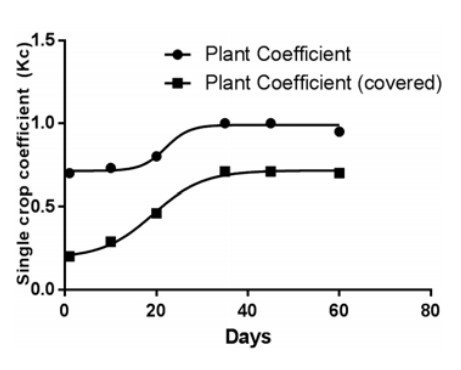
Figure 1. Lettuce crop coefficient for non-covered and surface covered cultivation assuming planting
of seedlings after 15 days (in the graph shown as day 0).
of seedlings after 15 days (in the graph shown as day 0).
Knowing both ETo and Kc, the crop evapotranspiration in m3 per m2 x day -1, and typically expressed in mm x day-1, was estimated as follows:

where ETc is the crop evapotranspiration (mm¨ day´1), Eto the reference evapotranspiration (mm x day-1), and
Kc the plant coefficient for lettuce (dimensionless).
The reference evapotranspiration for the natural light option has been estimated based on
measured hourly solar radiation data for Köln-Bonn (Table 1), Germany (50˝471 N; 7˝51 E) of 2014 [31]
representative for the Central European region. The temperature range within the greenhouse was
determined at 20–24 ˝C, the relative humidity set between 60% and 80%. It was assumed that the
greenhouse glazing transmittance reduces incident radiation by 10%. The shading factor due to
construction and surrounding reduced it by another 15%, which made us assume that the net radiation
of natural light under greenhouse conditions decreased by 25%. Figure 2 shows the estimated ETo
difference under natural and artificial lighting. The natural lighting reference evapotranspiration
can be expressed in to the following formula, which refers to the natural lighting curve in Figure 2
 where X is the time in months.
The reference evapotranspiration for the natural light option has been estimated based on
measured hourly solar radiation data for Köln-Bonn (Table 1), Germany (50˝471 N; 7˝51 E) of 2014 [31]
representative for the Central European region. The temperature range within the greenhouse was
determined at 20–24 ˝C, the relative humidity set between 60% and 80%. It was assumed that the
greenhouse glazing transmittance reduces incident radiation by 10%. The shading factor due to
construction and surrounding reduced it by another 15%, which made us assume that the net radiation
of natural light under greenhouse conditions decreased by 25%. Figure 2 shows the estimated ETo
difference under natural and artificial lighting. The natural lighting reference evapotranspiration
can be expressed in to the following formula, which refers to the natural lighting curve in Figure 2
where X is the time in months.
Add Comment